Thursday, December 4, 2014
Kirsten Soderholm: Blog 2
Throughout this entire semester, there are three pictures I have become fascinated with and I just can’t put my finger on why I am so mesmerized by them. All three of these paintings are by Dante Gabriel Rossetti, and all are portraits of a single female. Is it their face, clothing, the colors, their expression, or all combined into one? The questions are endless, and these exquisite paintings depict the female in the eye’s of the male gaze, but are also exceptionally iconic. Monna Vanna, Monna Rosa, and Water Willow all grasp my attention and fascination in an unexplainable way and I wonder if others have the same reaction.
As I look at them more in depth, I think I am most fascinated with their delicate features as in Water Willow, but most intrigued by the fashion and decorative elements in Monna Vanna and Monna Rosa. While the gowns in both of Rossetti’s Monna’s look extremely similar, the masses of wavy red hair, elaborate dress, flawless fur, and captivating jewels make Monna Vanna a more ornate image than Monna Rosa, whose only difference in color comes from the china vase. Although we have spent many classes discussing the male gaze, women as other, pleasure in looking, and women as something beautiful and desirable, I think maybe Rossetti just wanted to create jaw-dropping images of beautiful women, which were not just intended for the male gaze. In this time, as in the current moment, all women of especially the upper class strived to be well known, the most beautiful, or best dressed, but only a small fraction of women during this time actually rendered this reality, and would have loved to see these gorgeously rendered women.
In the article we read by Griselda Pollock entitled, “Women as Sign: Psychoanalytic Readings, Vision and Difference: Femininity, Feminism and the History of Art, 1988,” we see Pollock explore ideas of women as visibly different, a fantasy, and a sign of masculine desire. Pollock is trying to answer the question, ‘Why did women become equated with beauty – and why are men and women portrayed as polar opposites?’ One of my favorite points by Pollock is when she talks about women having power, since they attract men and create emotions, which is in itself powerful. However, this does not mean that females can’t have their own gaze as they look at these three portraits, or any of Rossetti’s female portraits, and also have an emotional reaction. It would not be then because the paintings are of women, but because they are each beautiful and distinctive in their own individual way. The female as other is consistently discussed, and even in my Shakespeare class my Professor quoted Aristotle who believed that women were inferior to men, and that a woman is an imperfect man. Why did men have such strong views about women? Were they intimidated, or just didn’t know enough about the opposite sex to understand that males and females are different but we all are still human beings?
Since male figures dominated the art world at this time, it always makes me wonder what it would have been like in this era if the roles had been reversed. What if Hunt, Rossetti, and Millais all were painting portraits of individual males as well, or just males and not females? Would the reactions and or controversies be different and why? These gender stereotypes have been around for eternity, and even right now, in our modern day society, we still cannot get rid of them. Constantly in the news there are headlines regarding women and equal pay, the first woman CEO, and numerous celebrities voicing their options on feminism, so will gender stereotypes ever change? Rossetti painted these stunning portraits for a reason, and I believe that all paintings should be for a male and female gaze because women are beautiful, but so are men. Rossetti just enhanced what one could maybe call the male gaze in painting, but these women in Monna Vanna, Monna Rosa, and Water Willow are glamorously portrayed, and everyone around the world should be able to see and appreciate that – not just men.
Works Cited:
Pollock, Griselda. Women as Sign: Psychoanalytic Readings, Vision and Difference: Femininity, Feminism and the History of Art. 1988.
Image Sources: Wikimedia, Tate Britain
Kyle Marquardt's Second Blog Post
What is a Pre-Raphaelite Landscape?
One of Prettejohn’s readings from this semester discussed Pre-Raphaelite landscape paintings. In the first two pages on the subject, the author gives four very different and in my mind somewhat incompatible descriptions of Pre-Raphaelite landscapes. The first is from Ruskin’s “Work”; he claims “Every Pre-Raphaelite landscape background is painted to the last touch, in open air, from the thing itself. Every Pre-Raphaelite figure, however studied in expression, is a true portrait of some living person.” In other words, a landscape scene must be pained outside and exactly as observed in order to be considered Pre-Raphaelite. Prettejohn offers a slightly different idea- the artists can claim their paintings “are true to nature in a special way – that the scene on canvas is a tangible result of an encounter with the natural world.” She goes on to say that these paintings “go beyond visual observation to encompass a more thoroughgoing physical experience of ‘nature’”. Here, Prettejohn argues that a truly pre-Raphaelite landscape is more than a simple observation transcribed into paint, the painting must embody the experience of making a particular observation. In other words, capturing the act of viewing as opposed to the view itself- a subtle but powerful difference- makes a pre-Raphaelite landscape special. A few sentences later, she quotes Barthes (a French theorist) saying, “in photography I can never deny that the thing has been there”. One can read this statement in relation to painting; a photo is a perfect snapshot of time, but a painting can never be this snapshot because paintings are not instantaneous in the same way. The argument contends that you can define Pre-Raphaelite landscape however you like, but it is not and can never be photographic. Different still from all these claims, and in direct opposition to the latter claim, are those of the artists who maintain, as Prettejohn said, “That they act like photographic cameras, recording only what was there in physical substance before their eyes.” (Prettejohn, 166)
I have taken all of these ideas, and several others, to generate my own modern understanding of what a Pre-Raphaelite landscape painting is and what it is not. Each of these claims from the reading has helped shape how I see not just Pre-Raphaelite landscapes, but all paintings under the label of “landscape”. Following is my understanding based on the course and its related material of what a Pre-Raphaelite landscape is.
Painting (or any art form) is about choices. Every choice made defines the work in some way. We, as viewers, put labels upon these choices made by the artists and that, for us, defines the painting. When the artist paints the outdoors we call it “landscape”. When they paint landscape while outside, we call it “landscape en plein air”. If an artist paints in hyper detail with a strong emphasis on nature (as well as other criteria but we’ll keep it simple), then we may label them “Pre-Raphaelite”. A Pre-Raphaelite painter must perform these things to generate a Pre-Raphaelite landscape, but the painting itself ends up being more- it is “of the thing” as Ruskin says, but not photographic as some of the artists have claimed. Rather, the painting captures the sensation of looking at world in the same way the artist does. Not necessarily true to nature, but rather, true to the artist's vision of what the world should look like.
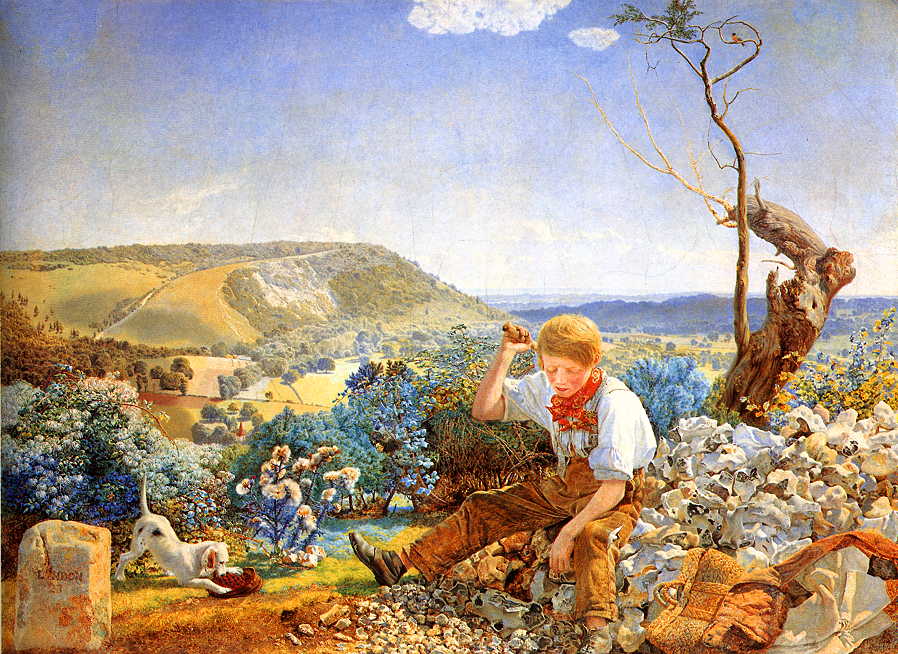
Take Brett’s Stonebreaker as an example:
The painting is falsified from reality in many ways, though still considered one of the best Pre-Raphaelite landscapes in existence. Brett inaccurately depicts the mile marker and the pile of stones his brother sits on in terms of their location; he “moves” Box hill in the background substantially closer to the viewer to shorten the mid-ground; the church shifts backwards so that it is visible in the scene, while in reality, its location remains behind the hill. The painting is highly detailed and “photographic” perhaps in its style, but not in its composition. This, in conjunction with his determination to paint the scene entirely from one spot while outdoors and using Pre-Raphaelite conventions, explains how Brett was able to capture his idealized view of a landscape and transcribe it into oil. This criteria makes Stonebreaker a Pre-Raphaelite landscape painting.
References:
Prettejohn, Liz, The Art of the Pre-Raphaelites, Tate Publishing, 2000
Payne, Christiana. 2010. John Brett, Pre-Raphaelite Landscape Painter. Yale University Press
Wednesday, December 3, 2014
Laura Blog Post #2: Pre-Raphaelite Nudity
After reading Smith’s article on the
Pre-Raphaelite view of nudity and discussing this article in class, it is
interesting to consider the reasons behind these views and compare them with
certain views of nudity and sexuality in popular culture today. The return to
painting the nude in the 1860’s was not extremely popular with many artists,
but one well-known supporter was William Etty. For the Pre-Raphaelites,
painting nudity was another way to go against the traditions of the Victorian
Era. The Victorian era, as discussed in class, was a very conservative time in
England where women were expected to be covered and submissive to men, views
that possibly descended from the conservative views in Christianity. The Royal
Academy curriculum also supported these views; students were not allowed to
paint the nude until after three years of study, which differed from the
French. Furthermore, by painting the nude, it went beyond simply an exposed
body, but the Royal Academy was concerned with the “moral integrity of the
model.” There was a fear that the
model’s virtue would be compromised if they were to sit for a nude portrait,
let alone exhibit it to the public.
Millais’ "Knight Errant" (1870)
and Leighton’s "Venus Disrobing" (1867) show some of the contrasts between nude
and naked as portrayed in art during this time. For Leighton, as Smith
discusses, he portrays Venus as the Greeks would, using classical knowledge and
technique. Venus is the Roman version of the Greek Aphrodite, the goddess of
sexuality and love. The goddess is not clothed, but seems comfortable in her body;
she is confident and graceful with a peaceful smile on her face. However, in
Millais’ "Knight Errant", Smith
explains this lack of filter on the woman’s naked body, unlike that of Venus.
She appears to be ashamed, scared, and there appears to be a scene where the
viewer is unaware of the exact events. It could have been a brutal scene,
implied by her being tied up and refusal to look at the knight. Unlike Venus,
Millais’ portrayal of the nude is not as the beautiful and seductive goddess,
but a woman with visible emotion. She looks like a real human being. This
brings the viewer closer to the person behind the painting, the model. While Leighton has a filter on his version
of the female nude, Millais’ nude is more naked, a shameful state that causes the
viewer to think deeply and feel uncomfortable about the lack of certainty of
her safety or profession.
Millais’
painting was a shocking piece for the Royal Academy in 1870, an era where people
were extremely conservative. Sexuality is still a complex topic in the media
today. In American society, sex is a selling point. Scantily clad women are constantly
in commercials and magazines. Even though women today have more freedom with
their bodies and appear constantly in advertisements, there is still an aura of
judgment surrounding these women and sexuality is still expected to be regarded
as a private subject. The acceptance of sexuality in art and the perception of it in every
day life is still a debatable subject today as it was in the Victorian
era.
Maggie Ray Post #2
This summary is not available. Please
click here to view the post.
Stephanie Rosicki Blog Post 2
The
Pre-Raphaelite interest of painting “en plein air”, or directly from nature,
can be seen from their hyper detailed style of artwork. Many Pre-Raphaelite
works were painted outside, allowing the artist to capture every minute detail
in each flower, tree, leaf, or water source of the scene, before painting their
subjects in. One example of a painting done in this hyper detailed style is
John Everett Millais Ophelia (1851-1852).
It is evident that a great amount of time was spent outside capturing every
detail, from the flowers in the foreground to the tiniest leaves in the
background. During the Victorian era, artists included flowers in their works
not only as a decorative touch, but as symbolism contributing to the intended
meaning of the painting. In Victorian England, flower symbolism was almost like
a second language. Those that studied art would understand what each flower
symbolized, allowing them to read further into the message the artist was
trying to get across. In Ophelia,
John Everett Millais included the flowers throughout the painting to enhance
the natural setting, but also to add symbolic meaning. The red poppy, which
floats by Ophelia’s hand, would be understood by the viewers of the Victorian
era as a symbol for sleep and death. Additionally, the inclusion of willows with
nettles growing in it, and the daisies by Ophelia’s hand would be understood as
symbols of forsaken love, pain, and innocence.
In the chapter, “The
Role of Women in De Morgan’s Later History Paintings” from the book Evelyn Pickering De Morgan and the Allegorical
Body the author, Elise Lawton Smith, explains the symbolism behind the
flowers painted in Evelyn Pickering De Morgan’s paintings. Regarding De
Morgan’s painting Flora (1894), she
states, “The pansies that decorate her dress were traditionally used to
symbolize a contemplative state of remembrance, while the roses that she holds refer
on one level to Ovid’s description of Flora, whose “lips breathed vernal
roses,” but also, given overblown blossoms that have fallen to the ground to
the ephemeral nature of earthly life” (Lawton Smith 91). This is only one
example of many of De Morgan’s pieces that contain flower symbolism, as others
are described in the chapter.
It is interesting that
the viewers of Pre-Raphaelite paintings during the Victorian era would have already
known what many of the flowers symbolized before seeing the piece, further
enhancing their own reading of the painting. Today, if an ordinary person were
to walk into a museum and happen upon one of these Pre-Raphaelite pieces, they
would not have the same reception that someone from the Victorian era would
have had. I find it interesting that many people today would not think twice
about the type of flower the artist chose to include in the piece. Unless the
viewers had previously studied Victorian art and had prior knowledge about the
“language” of flower symbolism, the original intention the artist had for the
painting would not be understood.
Sources:
De Morgan, Evelyn. "Flora." The Kissed Mouth:
Endless Digressions on Evelyn De Morgan. N.p., n.d.
Web. 2 Dec. 2014. <http://fannycornforth.blogspot.com/2011/09/endless-digressions-on-evelyn- de-morgan.html>.
Everett Millais, John. "Ophelia." Pre-Raphaleite
Sisterhood. N.p., n.d. Web. 2 Dec. 2014. <http://preraphaelitesisterhood.com/ophelias-flowers/>.
Lawton Smith, Elise. The Role of Women in De Morgan's
Later History Paintings. N.p.: n.p., n.d. Print.
Victorian Curiosities: Orchidelirium Tara's Blog 2
The
sciences where vastly expanding during the Pre-Raphaelite era, and these
scientific and technological advances where incorporated into the paintings of
the Pre-Raphaelites. Their use of new painting materials and pigments are one
example of these technologies.
Another very interesting phenomena happening during the Pre-Raphaelite
time period was an event later called “Orchidelirium” or “Orchid Mania”. These
terms refer to the vast collecting, trading, and eventually breeding of exotic
and/or rare orchids in Victorian Europe. Orchids were one of the curiosities of
the Victorian era, and they were a symbol of wealth and sophistication. I have
attached a link to a really great article on the ‘orchid hunters’ of the time.
The article discusses a collector and nursery cultivator of orchids in London,
Fredrick Sander. Sander was the Royal Orchid Grower to Queen Victoria, and was
in a very lucrative position as orchids were selling like ‘jewels’ at fairs in
London. Sander published two volumes of a book, Reichenbachia, which are both available at the special collections
in Memorial Library, and I highly recommend taking the time to look at them.
They have large, gorgeous colored plates of exotic orchids from Central and South
America. Memorial library has many other great orchid books from the Victorian
era, with equally beautiful illustrations.
I
believe orchids today are still a symbol of sophistication and wealth. Orchids
are often used to celebrate a special occasion. Luckily, there are more laws
today protecting the wild orchids and their habitats. There are estimated to be
around 25,000 species of orchids across the globe, making about one out of
every ten plant species an orchid. That is also about four times the amount of
species of mammals on earth! Orchid species are also found on every continent
(except for the North and South Poles) making them a beautiful spectacle across
the globe.
The
Victorian era was filled with discoveries of the natural world, and the orchid
caught the attention of many. The Pre-Raphaelites were also captivated by the
natural world, and their work accurately portrays their love for nature. Their
strong sense of flower symbolism can be linked the Victorian age of botanical
research. Convent Thoughts by Collins
is a great example of Victorian botanical interests and the Pre-Raphaelite eye
for detail. From trees to each blade of grass, the leaves and petals of the
flowers, this painting has amazing botanical accuracy. This theme is carried
throughout many paintings by the PRB, Ruskin was very interested in the idea of
beauty in natural details. Ruskin believed that nature was the work of God, and
that natural details should be rendered in exacting precision and be truthful
to ‘God’s handiwork’. These beliefs led to the exquisite craftsmanship that the
PRB are known for, which aimed to reflect the beauty of nature to their
viewers.
Here is the article link:http://www.lewisginter.org/blog/2012/04/14/by-hook-or-by-crook-the-plunder-of-orchids-from-the-new-world/
https://www.artrenewal.org/pages/artwork.php?artworkid=4477&size=large
Tuesday, December 2, 2014
Stillman's "Mariana" - Wing's Second Blog Post
During our class discussion on December 2nd, when we were comparing differences in paintings by male and female artists, I was particularly interested. In class we discussed how women artists attempted to show womanpower and to increase a woman's status in female portraits through the establishment of a large, more life-like forehead, the use of a three-dimensional background, a contemplative gaze, and poses that seemingly reach out more to the viewers, as opposed to those in Dante Gabriel Rossetti’s paintings. Appreciating their work, I found that in addition to the previous points, there are other elements in Marie Spartali Stillman’s paintings that work against the conventional understanding of women.
When Stillman was first introduced in class, we saw her works after Rossetti and at that time her half-length figures made a lot of sense to me. Yet when her Mariana (Figure 1, 1867-9) was shown on the screen, I could not help but wonder why she maintains this half-length figure rather than a full-length one like that in John Everett Millais' Mariana of 1851 (Figure 2). We may argue that this is her preference but why was she so insistent about this? Thinking back on both readings and in-class discussions, artworks in the Victorian period significantly focused on a woman’s fertility. One particular way to do this is to show her hips. Therefore, I would argue that Stillman’s often avoidance of the lower body would be likely to shift viewers’ attention to the figure’s emotions rather than her fertility. In Stillman's Mariana, the woman has her hands crossing under her chin, with eyes looking out of the window, through which the viewer can easily tell that she is contemplating. Her reintroduction of this figure challenges the viewers perception of women, unlike Millais’ depiction. Stillman presents a figure of Mariana that is not restricted to only household chores like tapestry creation, but rather argues that women can also be independent thinkers. Furthermore, there are not as many details in the background in Stillman's paintings as in others, which continues to serve for her goal of focusing on the model.
At this point, one might suggest that the large emphasis on the figure in Stillman’s painting lack understanding of the story and the purpose of the painting. Yet this might be the reason why Stillman has done a fair amount of paintings after male artists. In the end, drawing upon subjects that have already been introduced to the viewer, Stillman is able to fill the gap between the figures and the viewers that often exists in the work of male artists.
(Figure 1)
(Figure 2)
Subscribe to:
Posts (Atom)